7.2.2.2.1. Steel Beam Design Example
This example shows how a simply supported W530x72 steel element can be checked for moment when the beam is laterally supported, or unsupported. A 6m long beam is analyzed with two point loads as shown bellow. A plot of the beam analyzed is output as part of this example. The beam is assessed in three conditions: continuous lateral support is provided to the beam, the beam is unsupported and loaded on it’s top flange, and the loaded at it’s shear center.
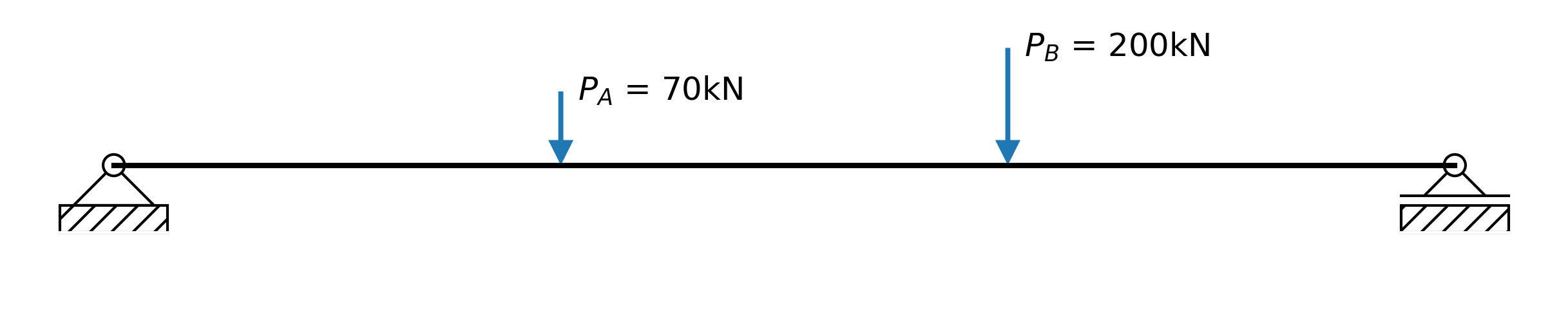
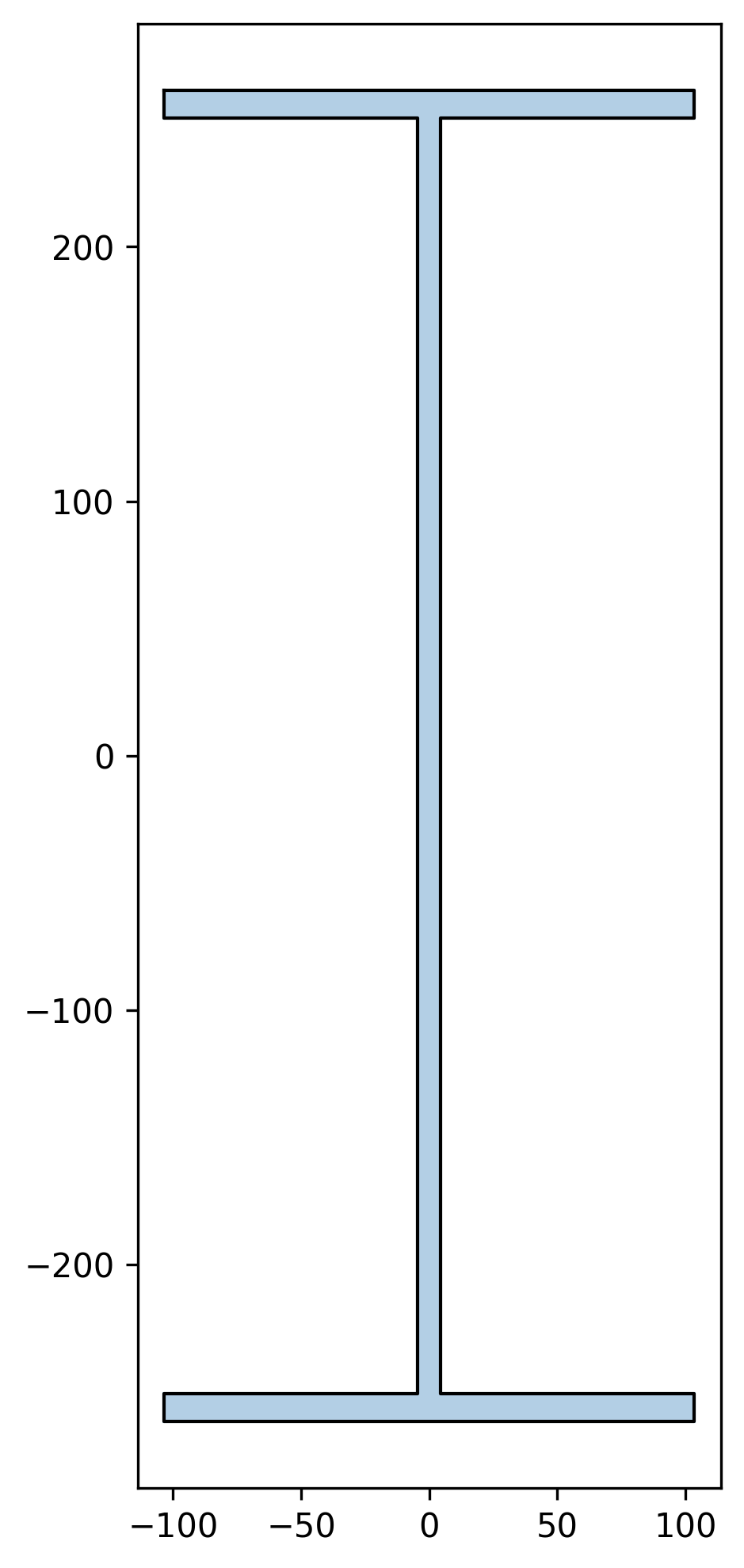
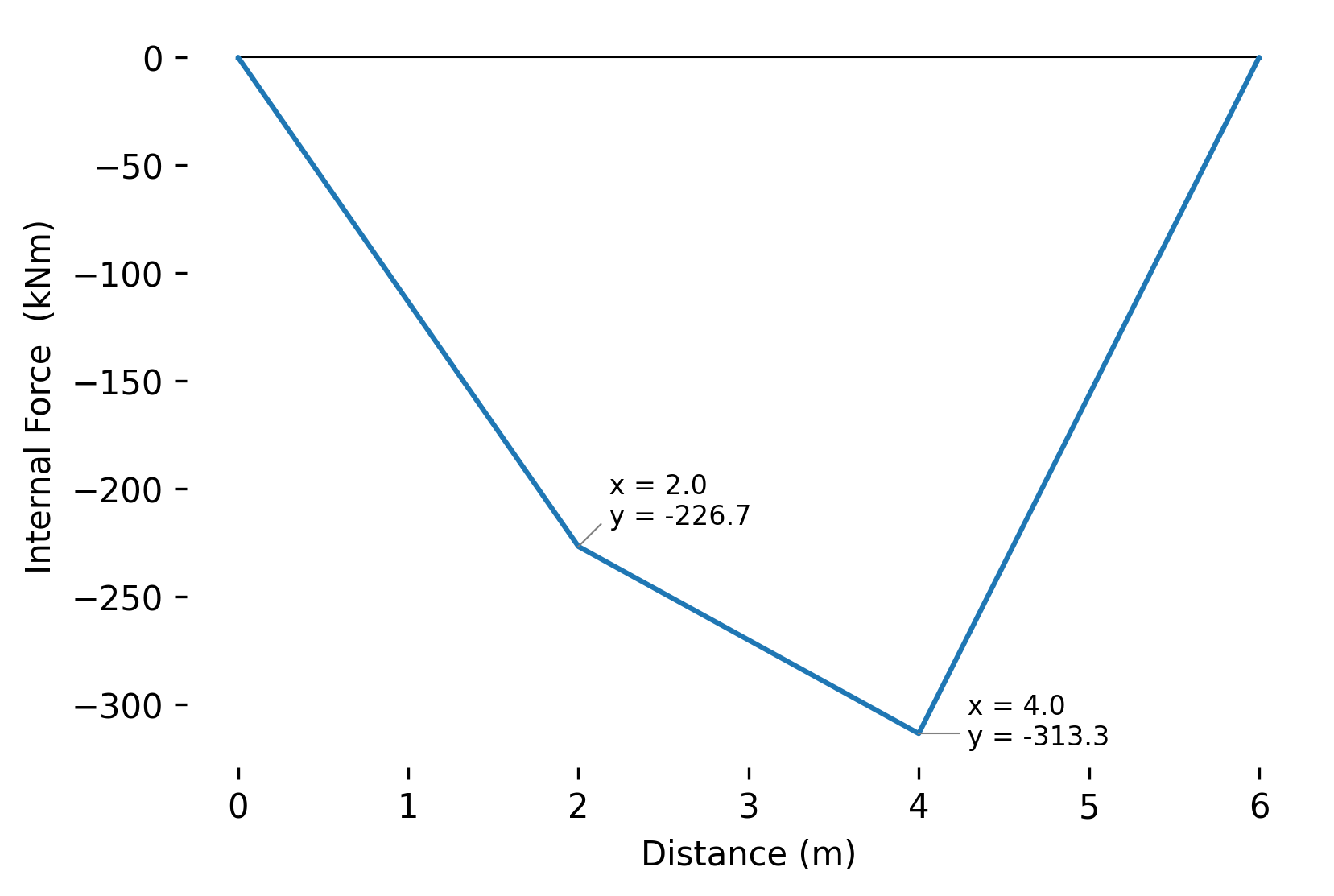
The capacity of the section is determined by limitstates, and compared to forces from an analyzed beam using the planesections library. First the base limitstates library is imported, then s16 steel design library for 2024. The library planesections is imported to run the beam analysis.
import limitstates as ls
import limitstates.design.csa.s16.c24 as s16
import planesections as ps
import numpy as np
Next the beam is created. First a material with 345MPa steel is set up using a design specific material, MaterialSteelCsa24 , and the W530x72 section is loaded from the aisc library, using si units using getSteelSections().
beamName = 'W530x72'
L  = 6
Fy = 345

mat = s16.MaterialSteelCsa24(Fy)
steelSections = ls.getSteelSections(mat, 'us', 'aisc_16_si', 'W')
section = ls.getByName(steelSections, beamName)
A simply supported member is then initialized, and the design properties of the beam are set. For the unsupported loading condition, it’s assumed that forces are applied to the top chord, and the simplied method of analysis will be used. Therefor, in this design the factors ω = 1, and kx = 1.2 is used. To achieve the longer unsupported length, a custom design property objects DesignPropsSteel24 is set with kx = 1.2. This length applies to the strong axis of the beam. The beam is simply supported so the typical member initiation function can be used, initSimplySupportedMember().
member = ls.initSimplySupportedMember(L, 'm')
props  = s16.DesignPropsSteel24(Lx = L, kx = 1.2)
beam   = s16.BeamColumnSteelCsa24(member, section, props)
The capacity of the beam is determined assuming it has continous lateral support (c.l. 13.5), and no lateral support (c.l. 13.6) with checkBeamMrSupported(), and checkBeamMrUnsupported().
MrSup = s16.checkBeamMrSupported(beam) / 1000
MrUnSup = s16.checkBeamMrUnsupportedW(beam, 1) / 1000
To analyze the beam, it is converted convert it to a planesections beam object, then apply our loading. A converter function in limistates can be used to directly transfer our beam over to planesections. A plot is also create a figure of the beam diagram. Refer to planesections documentation to see how to analyze an arbitrary beam.
# Make a plot
ls.plotElementSection(beam)

# Create a planesections beam object
beamPs      = ls.convertBeamColumnToPlanesections(beam)

# Apply some loading to the beam - assume it's factored.
kN = 1000
q = [0.,-35*kN]
beamPs.addVerticalLoad(L/3, -70*kN, label='A')
beamPs.addVerticalLoad(2*L/3, -200*kN, label='B')

# Make a diagram of the beam
ps.plotBeamDiagram(beamPs, labelForce=True, plotForceValue=True)

# Analyze the beam using pynite
analysis = ps.PyNiteAnalyzer2D(beamPs)
analysis.runAnalysis(recordOutput=True)

# Plot a bending moment diagram
ps.plotMoment(beamPs, 0.001, labelPOI=True, yunit='kNm')
The strength of the beam is then determined assuming it’s loaded at it’s shear center. This would be the case if purlins were framing into the side of the beam, and the loading was balanced, i.e. there was a purlin on either side of the beam.
The simplified method is no longer being used, so another beam is created which used the original beam length. The omega value of the beam can be determined based on omega from the bending moment diagram class DesignDiagram is used to determine omega.
props  = s16.DesignPropsSteel24(Lx = L)
beam   = s16.BeamColumnSteelCsa24(member, section, props)

xyBMD = beamPs.getBMD()
bmd = ls.DesignDiagram(np.column_stack(xyBMD))
omega = s16.getOmega1FromDesignDiagram(bmd)

MrShearCenter = s16.checkBeamMrUnsupportedW(beam, omega) / 1000
print(MrSup, MrUnSup, MrShearCenter)
- Based on this analysis, it can be see:
If the beam is laterally supported, it’s capacity is 472kNm and passes easily.
If the beam is laterally unsupported and loaded on it’s top flange, it’s cpacity is 181kNm and it fails by a large margin
If the beam is laterally unsupported and loaded at it’s shear center, it’s capacity is 315kNm and it barely passes.
Lateral support conditions are important and significantly influence beam strength!
The full example is below:
"""
This example shows how a simply supported W steel element can be checked for
moment when the beam is laterally supported, or unsupported.
A 6m long beam is analyzed with two point loads as shown bellow.
A plot of the beam analyzed is output as part of this example.
The beam is assessed in three conditions:
    continuous lateral support is provided to the beam,
    the beam is unsupported and loaded on it's top flange, and
    the loaded at it's shear center.
"""

"""
The capacity of the section is determined by limitstates, and compared
to forces from an analyzed beam using the planesections library.

First the base limitstates library is imported, then s16 steel design library.
The library planesections is imported to run the beam analysis.

"""
import limitstates as ls
import limitstates.design.csa.s16.c24 as s16
import planesections as ps
import numpy as np

"""
Next the beam is created. First a material with 345MPa steel is set up, and the
W530x72 section is loaded from the aisc library, using si units.

"""
beamName = 'W530x72'
L  = 6
Fy = 345

mat = s16.MaterialSteelCsa24(Fy)
steelSections = ls.getSteelSections(mat, 'us', 'aisc_16_si', 'W')
section = ls.getByName(steelSections, beamName)

"""
A simply supported member is initialized, and the design propreties of the beam
are set. For the unsupported loading condition, it's assumed that forces are
applied to the top chord, and the simplied method of analysis will be used.
Therefor, in this design the factors ω = 1, and kx = 1.2 is used.
"""
member = ls.initSimplySupportedMember(L, 'm')
props  = s16.DesignPropsSteel24(Lx = L, kx = 1.2)
beam   = s16.BeamColumnSteelCsa24(member, section, props)

"""
The capacity of the beam is determined assuming it has continous lateral
support (c.l. 13.5), and no lateral support (c.l. 13.6)
"""
MrSup = s16.checkBeamMrSupported(beam) / 1000
MrUnSup = s16.checkBeamMrUnsupportedW(beam, 1) / 1000

"""
To analyze the beam, it is converted convert it to a planesections beam object,
then apply our loading. A convert function in limistates can be used to
directly transfer our beam over. A plot  is also create a figure of the beam
diagram. Refer to planesections documentation to see how to analyze an
arbitrary beam.
"""
# Make a plot
ls.plotElementSection(beam)

# Create a planesections beam object
beamPs      = ls.convertBeamColumnToPlanesections(beam)

# Apply some loading to the beam - assume it's factored.
kN = 1000
q = [0.,-35*kN]
beamPs.addVerticalLoad(L/3, -70*kN, label='A')
beamPs.addVerticalLoad(2*L/3, -200*kN, label='B')

# Make a diagram of the beam
ps.plotBeamDiagram(beamPs, labelForce=True, plotForceValue=True)

# Analyze the beam using pynite
analysis = ps.PyNiteAnalyzer2D(beamPs)
analysis.runAnalysis(recordOutput=True)

# Plot a bending moment diagram
ps.plotMoment(beamPs, 0.001, labelPOI=True, yunit='kNm')

"""
The strength of the beam is then determined assuming it's loaded at it's shear
center. This would be the case if purlins were framing into the side of the
beam, and the loading was balanced, i.e. there was a purlin on either side of
the beam.
"""

props  = s16.DesignPropsSteel24(Lx = L)
beam   = s16.BeamColumnSteelCsa24(member, section, props)

xyBMD = beamPs.getBMD()
bmd = ls.DesignDiagram(np.column_stack(xyBMD))
omega = s16.getOmega1FromDesignDiagram(bmd)

MrShearCenter = s16.checkBeamMrUnsupportedW(beam, omega) / 1000
print(MrSup, MrUnSup, MrShearCenter)


"""
Based on our analysis:
    - If the beam is laterally supported, it passes easily.
    - If the beam is laterally unsupported and loaded on it's top flange, it fails by a large margin
    - If the beam is laterally unsupported and loaded at it's shear center, it barely passes.

"""